

Tools & Data
Explore polygenic risk score evaluations, research software, practical guides, and archived PRSweb releases.
Featured resource
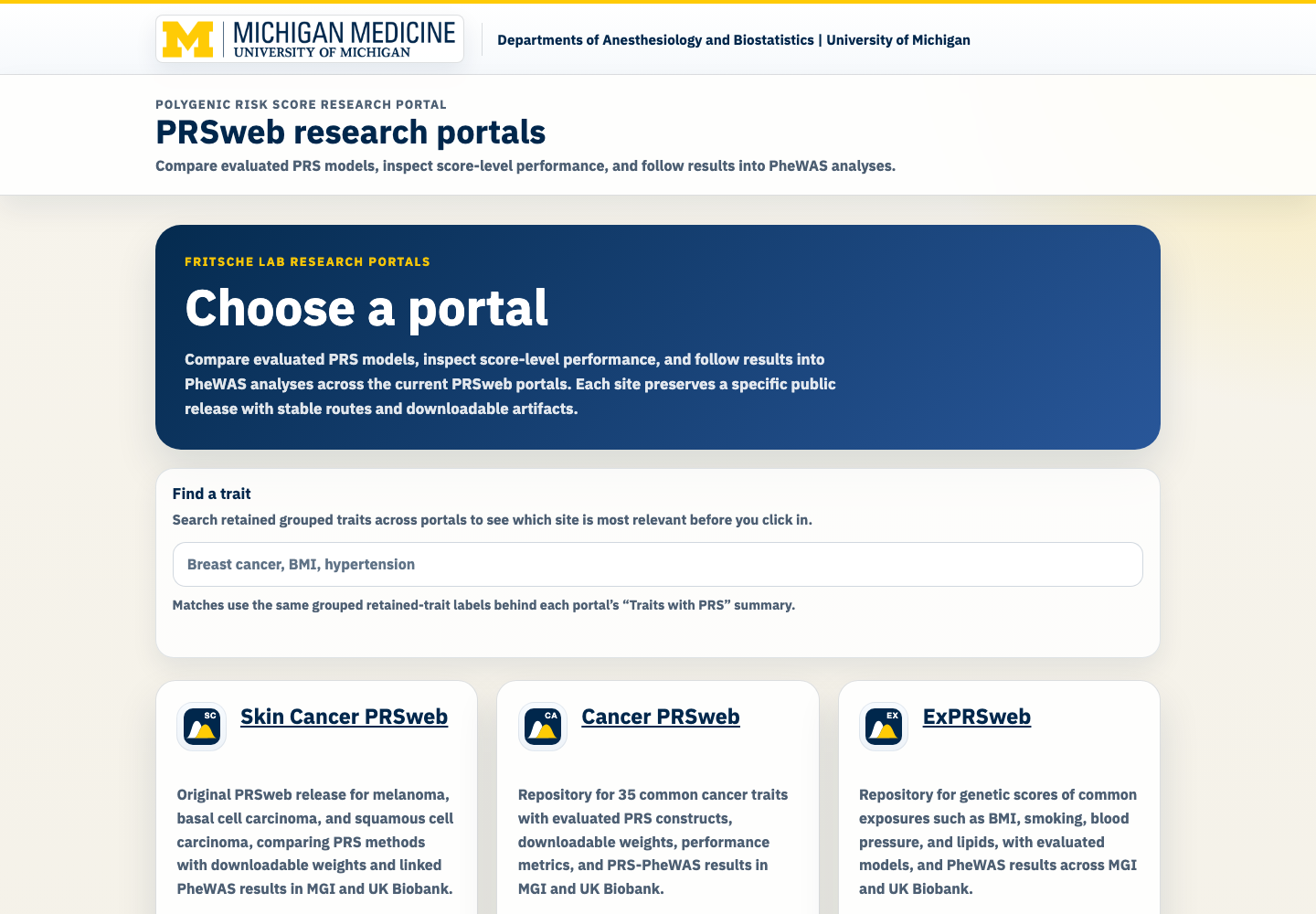
Public collectionPRSweb Research Portals
Compare published polygenic risk scores evaluated in the Michigan Genomics Initiative (MGI) and UK Biobank, and explore phenome-wide associations and downloadable files.
Useful for: finding traits across portals, comparing scores, examining performance and phenome-wide results, and downloading release files.
Archived PRSweb releases
These portals preserve the versions described in their papers. Their score files, mappings, and results remain available to help researchers reproduce or extend the published analyses.
Polygenic risk archive
Cancer PRSweb

The archived June 2020 release reports evaluations of cancer polygenic risk scores in the Michigan Genomics Initiative (MGI) and UK Biobank.
Polygenic risk archive
ExPRSweb

The archived November 2021 release reports evaluations of polygenic risk scores for common health-related exposures.
Polygenic risk archive
Skin Cancer PRSweb

The original June 2019 release evaluates 20 polygenic risk scores for melanoma, basal cell carcinoma, squamous cell carcinoma, and overall skin cancer.
Open tools and guides
PheWAS software
phewasFlow
An R package for reproducible phenome-wide association studies in both directions, with local and cluster workflows, multiple-testing correction, and Manhattan and volcano plots.
Research computing guide
Fritsche Lab SLURM Playbook
The SLURM Playbook covers submitting and monitoring CPU jobs and job arrays on U-M clusters, diagnosing failures, and rerunning only failed tasks.
Practical GenAI guides
Start with the coding workflow in Part 1, then put it into practice with a coding agent in Part 2. Use the guides for individual learning or a lab session.
Practical GenAI · Part 1
Teaching guidePractical GenAI Coding Guide
An eight-step workflow for AI-assisted research code, covering planning, prompting, review, testing, version control, and documentation.
Practical GenAI · Part 2
Teaching guidePractical GenAI Agentic Coding Guide
Six lessons for working with coding agents in a runnable research repository, from a task brief through implementation, testing, review, and handoff.